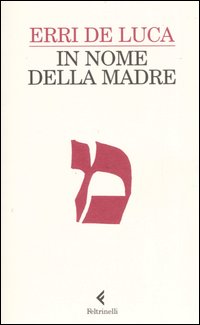
Returning from a weekend away, I am reviewing this little book (actually published a story not so long in solitary) whose reading took me last night, leaving me hanging in the balance between emotion and nausea.
Shall I or will the moon but this time I read books on which I can not take a firm position. In the name of the mother is a truly moving book. Talk of pregnancy by Miriam (Mary) of Nazareth, not to mention the advent of Christ. Telling the story of one who, at least in our Western culture, is the mother par excellence runs through the miracle of every mother, every birth.
I must admit that waiting for a child recently, this book hit me in the stomach. The biggest merit is that they can walk on hot coals to light steps of the sacred nativity - topic that has been said and written and now all the opposite of everything - almost taking the game in favor of the most profound mystery of human birth, a mystery in which everyone, sooner or later, we are facing.
An exceptional value, really. But maybe a big flaw. It will be for my refractoriness to Catholic dogma, the attitude will be critical for the prevention and chronic now, but the first thing I read was asked if there really need to bother the Lady to give this book a raison d ' exist.
Perhaps it is not so and I am mistaken. And then we need more people able to live and tell the faith as De Luca, with immanence and simplicity. The question remains, however, and this is what I nausea: why, for a change, tell the story of this woman so special, whose son has come on purpose to show us that we are all equally special ?
I do not know. The figure of this Mariam bold, almost arrogant in his reason and his faith, unaware of this unconsciousness and strong is such a cliché that I now stomach. Yet De Luca has been able to make sense of this too, giving a wonderful definition of "grace" and the grace with which Mariam (as all good children know) is full.
The other thing that leaves me dumbfounded and a little 'angry, as admired, is the discovery that it had to wait for a man, not a woman, would write something like that. Before being accused of sexism or worse: my wife was moved and enchanted by this, far more than it has been me. So I'm not praising the sword is the wisdom of the writer Masculo .
Instead, I wondered why I never read or heard anything like it in the work of a woman. And maybe the last pages, De Luca I wanted to give an explanation between the lines. How often we hear that a man can not understand the mystery of a new life? Sure, he can not live, can not live like in the chest, the head of another man, who is male or female. This impairment we bring it inside, who cares more, who cares less.
yesterday for the first time I found myself thinking that there is some sort of jealousy in this intimate and contemptuous cliché all women, the same jealousy with which some wives make a mockery of men unable to cook a pasta dish with tomato. They complain of the entire male gender, carrying their husbands spoiled for example, doing everything with the same brush and forget the crowds of chefs (men) who populate the kitchens everywhere. Attitude, however, male identity (only on other topics).
Yesterday my wife and I we were to read and share each other's arms this mystery in silence, each in its own way but close to each other and share and-together-of our son. Here, it pains me a bit 'that this wonderful feeling there was donated by a man ... knows is false experience, excellent fiction.
In any case, better that a book leaves you dumbfounded that indifferent. So, congratulations to Lucas for this little gem that every couple should read during the first hold.


0 comments:
Post a Comment